

A tale of two countries – the 2026 Local and National elections in Great Britain
In England, Greens quadrupled their existing 146 council seats in areas with elections to 587 councillors. Cities, especially Remain-voting areas, went Green.
Charles Dickens wrote, "It was the best of times, it was the worst of times,” about revolutionary France. But many progressives observing the results of the UK’s 2026 local elections will see a parallel. Even ten years after the Brexit vote, there remains a deep fracture in our politics between areas and people who voted Remain and those who voted Leave, not dissimilar to the fissures that followed the ‘exit’ of France’s monarchy after the French Revolution.
In England, Greens quadrupled their existing 146 council seats in areas with elections to 587 councillors. Cities, especially Remain-voting areas, went Green. The party won two Mayoralities and an absolute majority in three London boroughs (Lewisham, Waltham Forest and Hackney) and is in a good position to lead the administration in Lambeth, Haringey and Southwark. It could also be amongst the scrum grappling for influence in five other No Overall Control boroughs. In Manchester, where just a third of seats were contested, they won 18 of 32 seats!
And yet, there was no denying that Reform came out as clear winners in England, especially in areas that voted Leave in 2016, capturing 1,453 seats, knocking Labour, with 1068 councillors, to a distant second place. The Liberal Democrats’ gain of 155 to 844 relegates the Conservatives to fourth place with 801 seats.
Scotland and Wales also held elections in their national assemblies. SNP remains the biggest party at Holyrood but is 7 seats from a majority, Scottish Greens won 15 seats (up from 9) placing them ahead of the Conservatives and the Lib Dems. Wales expanded its Senedd and switched to an entirely list-based PR system. Plaid Cymru won 43 of the 96 seats, Reform second with 34 seats from zero and Labour with 9 seats a distant third. Greens managed 2 seats in Cardiff giving them representation in the Senedd for the first time. It was a catastrophic result for Labour, losing control after a century, and its leader lost her seat.
Election results in England by number of Councillors elected
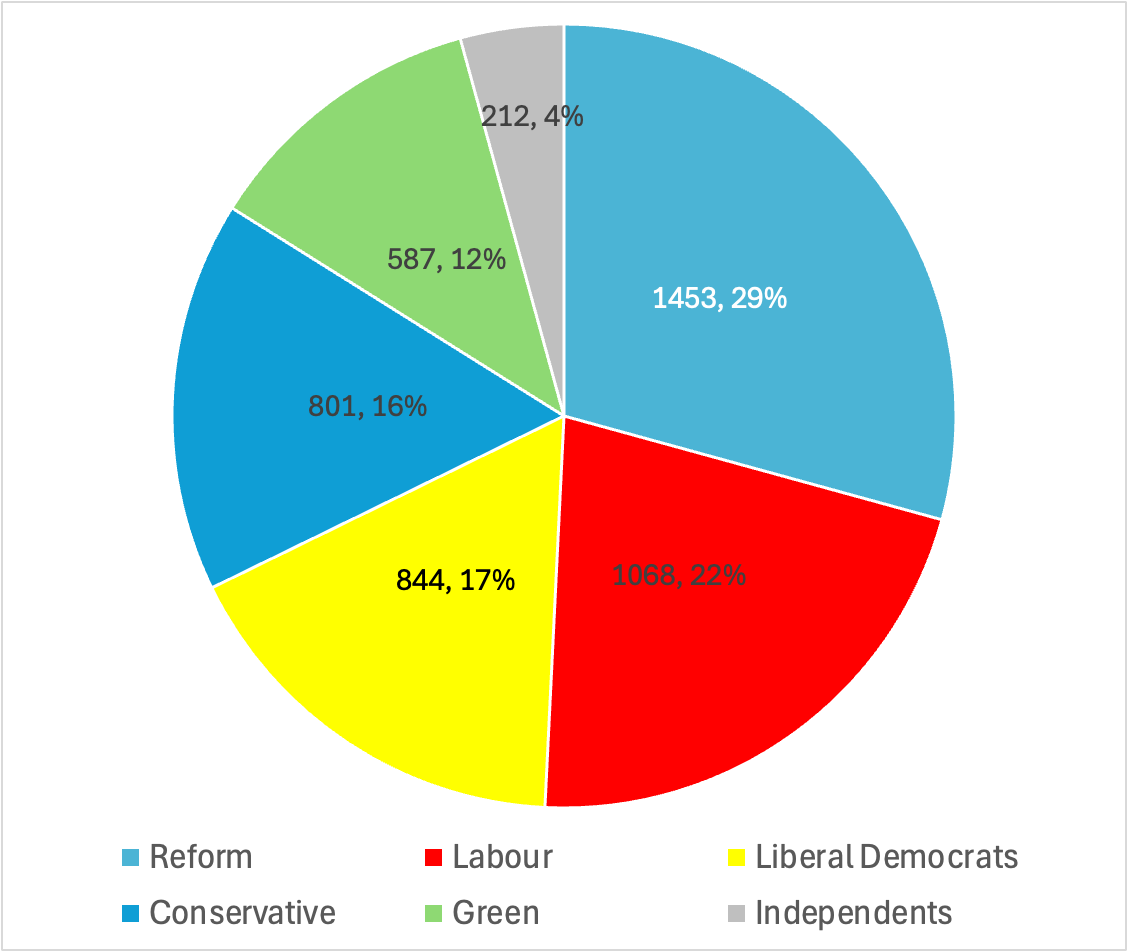
As others have observed, England’s century-long Labour–Conservative duopoly is over, and now five parties hold over 10 per cent of the contested council seats in England despite the first-past-the-post system. The unfairness of FPTP to smaller parties remains (Greens with 17% of the vote won but 12% of seats), but targeting and vote fragmentation has helped mitigate this imbalance.
The situation is different in the other nations where the nationalist parties have emerged as the winners (Sinn Féin is the largest party and selects the First Minister with 27 of the 90 seats in the Northern Ireland Assembly in the 2022 elections) in this flight from the traditional parties.
Reform and the Green Party can show how well they administer the eighteen English local authorities they control. Their mandate for radical change will almost inevitably be frustrated by the local government’s limited legal powers and financial autonomy, but the next few years will be portrayed as a test of how well they deploy actual political leadership. In a thought-provoking article, ‘Is There a Green Ceiling? ’ Rupert Read, reflecting on his recent experiences canvassing, asks whether being seen as ‘polarising populists’ guilty of ‘attention-grabbing culture-warriorism’ limits the Party’s appeal. Many will baulk at this characterisation as a figment of a biased press’s imagination, but this is a necessary discussion, especially if they persist on giving Reform a pass and fail to scrutinise their actions.
The Green Party has arguably had its best-ever election result, but no one can assume this momentum will be sustained. To broaden its appeal, the Green Party needs to conceptualise, communicate and operationalise its vision of society. Given the current political mathematics, it also needs to reach out to other progressive political parties and figure out how they must all support one another to stave off the far-right.