Changemakers: Ed Mayo
“The old world is dying, and the new world struggles to be born.” But in this time of monsters, how will that new world come into being?
For this new series, Green House talks with leading activists and radical thinkers about the changes they want to see – and how, in the real world, positive change can happen.
We kick off with Ed Mayo, former Secretary General of Co-operatives UK and one of the team that started the Fairtrade Mark. Ed’s books include Consumer Kids, Values and A Short History of Co-operation and Mutuality.
Green House: Ed, what are the main changes we need to see for the transition to more sustainable futures?
Change will come fast and some of it will be forced on us anyway, but we need to be strategic and not just tactical in the change we promote.
Start with actions that have a double effect. They improve resilience to ecological, social and economic shocks and also act as a symbolic pathway to wider transformation, offering movement and momentum towards a more balanced and sustainable way of operating.
Take renewable energy co-ops, of which there are around 2,500 active or in formation across Europe. These are best known for being a form of generation of clean energy or demand-side savings of greenhouse gases. But what they're also doing is improving communities’ self-reliance – and therefore resilience – in the face of shocks, because by and large these are decentralised technologies and operating in community ownership.
Community energy is a double win because it both advances an ecological path and also supports that underlying resilience at a more local level. It engages with reality but prompts scope to dream, to imagine alternative realities, different ways of being.
You can call these low-hanging fruits and ask how many of them there really are. And that's a reasonable question. Because it takes us very quickly to deeper, structural questions of how we organise economic life, and in particular the nature of technology.
Technology is not just your coding, data banks, AI models, or online platforms. Technology is a set of tools that support people to organise and to take action, and can be shaped to be socially useful. So micro renewables, as an example, have that double quality of subsidiarity and a bent to sustainability.
The larger question is, where does control of the adoption and the rollout of technology across society and the economy lie? That's starting to move upstream from some of these downstream community solutions. It means that the core imperative is around challenging, accountability, regulation, control and ownership of technology. And at the moment, that's rarely considered.
There's been some work done from an anti-cartel and anti-monopoly perspective - for example, work within the UK through the Competition Markets Authority. But this has been sat on by the current government.
There’s also been some work within the EU, through slow-moving challenges to Google and others. And prior to Trump, there was work looking at the monopoly behaviour of big tech and the tech bros in the United States. At the moment, in the heady days of investment in AI infrastructure, these have all been quietened.
But ultimately, it's the social control and shaping of technology which would release more positive, enabling, people-centred and human-scale models and initiatives.
It sounds like there are good things that could happen, but there are reasons that they haven't progressed – and that your theory of change is as much about stopping what's stopping change as it is about enabling the good stuff. How do you see the balance between those two, or the ways they might work together or not?
I think change involves different actors and different methods over time. There are areas where I’ve seen transformative change within bounded remits - and you can see different actors playing different roles and different methods being successful.
One group is social and community enterprises or cooperatives – initiatives and ventures that play a critical role in providing practical solutions. They’re viable within the current market and wider social system, but also flip things over so that people's participation starts to embrace a much deeper paradigm change.
I think of that as a triangle where you've got a lever on top. One side of that lever is about meeting practical needs. For example, fair trade meets people's needs for ethical chocolate. But at the same time, getting involved in fair trade can flip you over to a very different way of understanding global exchange and the value of a cooperative value chain that extends all the way back to democratic producer co-ops.
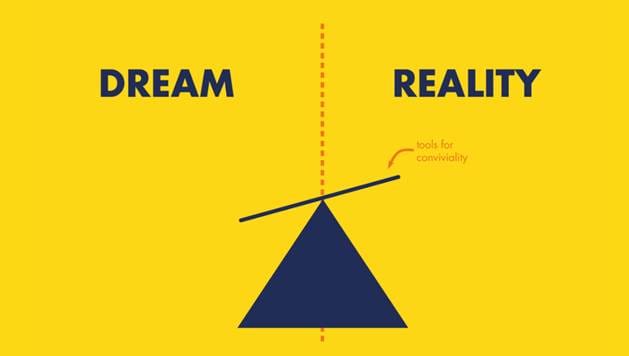
So it’s like Ivan Illich’s idea of “tools for conviviality” – thinking about technology as tools that come in many different forms. Some of them are subject to power interests – they can be taken over, colonised and privatised. But where things like fair trade have got social movements – such as producers and farmer groups – involved, they hold on to a form of accountability. So community enterprises are one group.
A second group is the campaigners and the activists - the “brick throwers” who sue Gatwick or Heathrow expansion, for example. This group may also participate in those social enterprises and those co-ops, e.g. by giving money, trading or the like, but their logic and their method of operating is different, and it's about challenging those in power.
As the third group, you have insiders within the institutions of power, such as private sector companies, the state and other senior non-profit bodies. They’re the people doing the long march of institutional reform, of trying to engage and work through existing institutions.
Sometimes those groups can come together and operate in synergy. The example I’d give would be the story of community banking in the United States.
People assume that the US is a pure market-driven model. In banking, that's not the case. Banking is heavily socialised and subject to significant regulation, which has meant that, alongside a shift towards consolidation in the banking sector, there was a rise in community banking.
It's somewhat like Karl Polanyi's “double movement”. The idea that damaging practices happen and that you get a response. For example, you might get industrialisation of agriculture, followed by a response at the margin like organic and regenerative agriculture. The rise of community banking was built on the passing in the US of the Home Mortgage Disclosure Act and Community Reinvestment Act in the 1970s. This was the result of work of activists like Gail Cincotta, who were going into Wall Street with campaigners holding up large streams of red ribbon, accusing banks of redlining communities or not lending to communities on the basis of their ethnicity.
The idea was that banks need a mandate to operate and serve all the community. In the US, banks now are under an obligation to serve all communities in an affirmative way. This has meant that banks have started to put more attention, focus and resource both into more inclusive provision, but also into partnerships with those community enterprises – the community development credit unions, community banks or Community Development Financial Institutions (CDFIs) as they're called in the United States. There’s been a rising movement there that's been supported by the state at different times, e.g. through capital grants and other models.
What I'm painting there is a picture that actually links practice and campaigning into a positive synergy. The key is to connect opposition and proposition – what we are campaigning against and what we are campaigning for.
If your theory of change is just about policy change, then you're focused on policy announcements. In contrast, when you're a practitioner involved in practical initiatives – as I tend to have been over my life – you're taking a more medium-term view. You're not expecting change to take place over a three-to-five-year period; you're looking at ten years as a minimum. What you're looking for is policies that align and create a slipstream and bandwidth that can support those patient long-term community institutions to develop.
Given your version of the theory of change, what would you say we need to do to sufficiently change the economy in the light of growing inequality and climate change?
Okay, so we've touched a little bit on who or what the main agents of change are. I think my own sense on this is that there's a need to marry different models of change in different areas and at different levels.
I've talked about the patient building from below and horizontal change, and I could talk more about that. Another example is the Emilia-Romagna region in Northern Italy, and how the cooperative movement there has bootstrapped, but also developed secondary institutions. This has meant that it's the region of Europe with the highest proportion of cooperatives (generating around 40% of Gross Value Added, GVA, in the region), but it is also the region with the lowest inequalities between rich and poor.[1]
So that's an example of building from below, but instead of seeing the answer as creating one more community or social enterprise, it’s about thinking systematically about the institutions that are required to succeed - education, capital formation, and so on. At present, the rise of action and innovation in the social economy reflects a combination of factors, including the erosion of the welfare state, intractable challenges, new social movements and the collaborative possibilities of new technology.
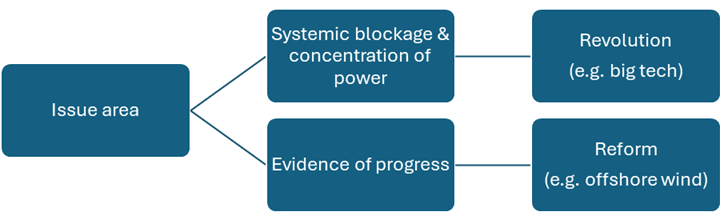
However, my sense is that more radical change in different forms and in different areas is also needed. I tend to think that we've got good examples of change happening in relatively short order at the economic level, where you can say: “these are cases that we can accelerate, but we're building on existing momentum”. In those cases, the answer is policy reform rather than no change or revolution.
An example of that is UK offshore wind, which is turning 25 years old shortly. Ironically, it was built on some of the engineering expertise developed for offshore oil platforms in the North Sea, but it’s actually been an extraordinary success story, with intelligent policy in the UK. Other countries have looked to copy models like Contract for Difference. It is an extraordinary story of moving towards renewable energy in a significant way, and of huge learning. So much of what we're talking about is the need to learn and learn faster, and that sector has absolutely done it. There are good examples like this where you can speed up things that are going in the right direction.
Then you've got areas where you can’t avoid the need for revolution. In my view, technology is the one area where you need such a revolution. For all the fascination of technology advances such as generative AI, and where this might take us, there’s not enough focus on the critical underlying question, which is who owns and controls the technology.
Talking about revolution often sounds like it's just on a t-shirt or wishful thinking. But at the moment, I think there’s no credible reformist policy that can address the challenges of appropriate technology, short of a revolution in ownership of technology and technology firms themselves. So, I would be arguing for reformist policy to support renewable energy, for example. But in wider technology, we need an out-and-out revolution.
That raises difficult questions: How do you do that? What can you do democratically? How do you actually engineer a revolution? At the moment, I don't have an answer to that. But it does start with awareness raising, activism and mobilisation around this and possibly the kind of unilateral isolationist policy stances that the US has been able to get away with. Whether the UK would be big and strong enough to take on the US over technology ownership and control, I just don't know, but we need to be thinking wider than the UK as well.
My sense is we're going to be going at different speeds. Not everything can be a revolution because revolutions are typically not good news. They don't lead to positive results. But in this one area, I think we actually need to be advocating revolution.
Are there any other areas where you think we need to take a more radical approach?
I focus on control of technology because technology is a core shaper and driver. The technology choices that we make are critical to the economic patterns that come forward.
I'd also love to highlight ownership of the media, because that’s also an area where, without more pluralistic media, we can never get the public education, public engagement and more participatory approaches to shift onto a more positive stance. But the risk is that you can't do revolution for everything.
Calling it a revolution may be too “barricades-y”. What we're talking about is a forcible redistribution of control rights – so it could be done by the state. In the media, that would be through regulation, and that could be done. Technology is hard to do at a national level; it's going to be multi-level. But fundamentally, it is about who controls those parts of the economy.
If you want to challenge areas like big tech and media, what do you see as the theory of change for doing that? Who are the agents of that change?
Well, obviously public education, campaigning, and building the mandate for radical change are important and will be part of this. That almost goes without saying. But the policy instruments that are used to act on these can be more precise.
With the media, this is about regulation. We have got media regulation – admittedly more regulation of traditional media than social media – and we have got a media regulator in place. Restricting cross-ownership of media in the name of promoting a more balanced and diverse media ecosystem would be a relatively clean and straightforward thing. It would be resisted by the press barons and otherwise, but we're going to have to take these ones on anyway when it comes to general elections.
At the moment, everybody's suspicious of people in power, so why shouldn't they be suspicious of people in media power? That can work to our advantage. So change on the media side comes through legislative action to enforce a regulatory pathway towards more diverse media ownership and limits on cross-media ownership.
The technology side is obviously more complicated because we need to build up from the bottom as well as challenge those at the top. I think the opportunity on the top-down side, if there's a scalpel here rather than an axe or a bludgeon, is competition policy. Competition policy is a really interesting area. It's quite technical, it's hard to work in because it's expensive – because competition economists are expensive – and people tend to ignore it. They just think: “Oh, let them get on with it.”
The interesting thing about competition economics is that it's based on exactly the same assumptions of zero externalities as trade economics, energy policy or agriculture. But in agriculture and energy policy, that’s clearly nonsense, and corrective action is needed to address those market failures.
In competition policy, there’s been no corrective action to start penalising polluting activities For example, pesticide or nitrate runoff by farmers would be penalised because it's essentially anti-competitive.
At the moment, all the bottom-up green initiatives that we've got tend to be more expensive. And they're expensive for a simple reason: they’re intentionally trying to internalise external costs in a voluntary capacity and sell that as a value offer through to customers. And of course, it then attracts fewer customers because there's a price trade-off. But actually, competition economics ought to be saying: “You shouldn't be selling food that is polluting”. There should be a rebalancing of the price on that ground.
Competition policy is possibly the only part of the economic toolkit that hasn’t been “greened” in any way whatsoever. The Competition Markets Authority has got no real understanding or capacity to see the ramifications of what it does, because it's working to mathematical models that don't easily encompass those externalities.
Competition policy is an extraordinarily powerful policy toolkit. If you've got a company that’s behaving like a monopoly, competition policy can break that company up and force the sell-off of different parts of the business. It can introduce market remedies that are deep and structural, and it's hard to think of another part of the governmental apparatus that actually has that “nuclear option” in terms of making dramatic change within a market sector.
Say you've got large parts of the UK economy that are owned by the US. How would that competition policy apply to large businesses in the UK that have foreign ownership?
Well, the Competition Markets Authority operates within a UK remit. You might have border adjustments, but essentially its remedies are in relation to activities within the UK.
The EU currently has the strongest, most progressive approach to competition policy, but that's still limited. The EU is big enough to tell Google: “You can't use search bundled up into different proprietary packages”, and Google will take it off for Europe, but probably also take it off worldwide because the EU is big enough as a bloc.
For competition policy to operate internationally, you've got to be able to operate not just in the UK. There are challenges there. But how is the revolution enacted? It's enacted by seizing the powers and the capabilities of competition law.
Legislative change supports that, but essentially it’s about greening those competition authorities and then having them act. The revolution is not about throwing stones at Microsoft Windows and breaking things down – it’s that popular mandate for a market remedy to address the level of control that's in there.
What is the best way to communicate and generate support for what's needed, and what gives you hope?
I think that it's easy for radical parties, such as the Green Party, to end up carrying every radical cause and coming across as unachievable as a result.
Thinking about how we could introduce a radical focus, the Lib Dems’ “a penny for the NHS” was one of the most influential election stances because it was very simple. People could understand it and think: “Okay, if you vote for them, that's what you get”.
It’s about parties really choosing to communicate the policy actions that would be prioritised in a first term. How much you can do within a first term is limited. If this is in partnership or coalition with others, it’s even more limited – so perhaps even more reason, pragmatically, to have a smaller number of the absolutely critical policy actions.
Because the wider you get, the more people can see things that they disagree with. Or they might agree on one thing, e.g. land reform, but disagree on another. I think the answer is not to aim to be all things radical to all people that might have an interest in radical solutions, because you end up with subtraction rather than addition, in terms of support.
And hope?
We don't know what’s going to emerge from the chaos of systems breakdown and overshoots of ecological thresholds. It's not predictable in any kind of easy way. This means that the most important thing is to invest in participatory systems to support complex collective intelligence and adaptation, and systems of resilience and collaboration that build the will to take joint action, whether that's at the local level or at an international solidarity level.
To my mind, I’d just invest in practical, cooperative action from the grassroots, both because we have no other choice and because the time it takes for these things to unfold will reveal what the relevance is, as well as what the next steps are in terms of building on those.
So, for me, hope comes from the sheer unknowability of it all.
[1] https://library.uniteddiversity.coop/Cooperatives/The_Co-operative_Advantage-Innovation_co-operation_and_why_sharing_business_ownership_is_good_for_Britain.pdf