Changemakers: Simon Birkett
"Air, climate, water and contaminated land can all be part of a new theory of change where a focus on one can lead to wins for all."
Simon Birkett is the Founder and Director of Clean Air in London (CAL), whose aim is to achieve full compliance with the World Health Organization's air quality guidelines throughout London and elsewhere. CAL works closely with other campaign groups and a wide network of supporters and volunteers to identify and build understanding of the most important issues around air pollution and encourage decisive action on them.
Between 2015 and 2019, Simon was the air pollution stakeholder on the High Level Inter-Governmental and Stakeholder Advisory Group for UNEP’s Sixth Global Environment Outlook (GEO6) – the United Nations’ most comprehensive report on the global environment since 2012.
Simon Birkett (SB) was interviewed by Tom Scott (TS).
-------
TS: Simon, you’re coming at environmental change from a rather different perspective, I think, to many of the people we’ve spoken to. Can you say a little bit about your background?
SB: I did civil engineering at the University of Melbourne and got first class honours. Then I was the only graduate engineer taken on by Consolidated Goldfields Australia in 1982. So I worked underground blowing things up for a while, before going to business school and then investment banking.
TS: Certainly very different to most people's stereotypical idea of an environmental campaigner! But you’ve been campaigning on clean air, hugely effectively, for over 20 years. How did that happen – what was the starting point for you?
SB: I grew up in Australia, not exactly playing in the outback, but in the bush – building dams across streams. And one of the first songs that caught my attention was something called ‘Pollution’ by Tom Lehrer, which I think came out in 1965. I've always cared about the environment. How I ended up in investment banking was, I guess, a different story.
In the early 1990s, one of my mentors within the bank I worked for, HSBC, was looking for a guinea pig to go on a course that the bank was exploring, which was about how societies and cities work, the complexity of them. He asked me to be the guinea pig because I'd specialised in the bank in solving complex problems and getting things done. And they knew I was up for trying things.
So I did this course and it was fascinating; learning about law and order, health, transport and various other things. A few years later, the same mentor became a near neighbour in Knightsbridge and I ended up getting involved in the local community there. And he got me involved in a campaign against traffic rat-running through local roads.
We took Westminster City Council to the High Court, beating them in a judicial review challenge. But Westminster just went back, ticked all the legal boxes and carried on doing what they wanted to do. So I had this realisation that you can't persuade politicians to do things they don't want to do and don't have to do.
A little bit later, the same chap said, “Well, isn't pollution bad around here?” He was looking for another angle to tackle the Council, I guess. And so I did a bit of research over a weekend and found it actually was quite bad in central London. And I started writing letters. We’d found a new theory of change.
This was in early 2006, when most of the environmental NGOs had stopped campaigning on air pollution and were campaigning for what’s now the Climate Change Act 2008. Friends of the Earth – apart from Jenny Bates – had put all their resources into that. So when I started getting involved, it was a bit like being a bubble in a vacuum – things just kept expanding. Whenever I asked people for help, they said yes. Wherever I tried to do things, they would happen. It was a very exciting time.
The first letter I wrote was to [then Mayor of London] Ken Livingstone. And the second was to the European Commissioner for the Environment. Next thing I knew, someone from Brussels called me up and said, “We're rather interested in what you have to say.” And in many ways, that's continued throughout – getting those rewards or bits of satisfaction along the way, where something surprising or quite wonderful happens.
TS: I guess what you identified was that the health impacts of clean air were a way of perhaps getting government to act in accordance with public health requirements where they might not be prepared to act for wider environmental reasons?
SB: Well, yes, because air quality is an issue which pulls together threads of everything. It's about health, it's about traffic, noise, quality of life, all these different things. And it's an easy way to carry people with you where some of these other things are less easy. Air quality can be part of a new theory of environmental change that can tackle more than rat-running traffic.
I talked to a lot of people, and listened – I was looking for a structure and a vision. And I decided that Clean Air in London's mission would be to achieve full compliance, urgently and sustainably, with World Health Organization (WHO) guidelines throughout London and elsewhere.
The vision I had and still have – and I'm sure it was actually right – is that you need to think of ‘one atmosphere’ or ‘one air’ – encompassing both air quality and greenhouse gases. You can think of those – air quality and greenhouse gases – as being two columns in a matrix, with two rows for London (or New York, Beijing or Manchester) and the Rest of the World.
To me, thinking only of the climate change targets for 2050 and other years is sort of like generals behind the front lines, in a chateau in the First World War, drawing sweeping lines on a map to invade France or Germany. Whereas if you focus on that top left box, that’s more like the trenches where it happens. People can understand air pollution in London. They can see it during air pollution episodes. They can see stuff coming out of chimneys or exhaust pipes.
My vision was that if you can basically just focus all day, every day on that top left box, you can actually show, through a mixture of political leadership, technology and lifestyle changes, how you can crack not just air pollution in London, but also how you can tackle these global environmental and climate issues. For me, that's the vision. And that’s what I’ve done – focused on that top left box, air pollution in London.
My two-by-two matrix has a third dimension. You could call it ‘London and up‘. So I chair a neighbourhood forum, I pressure the Mayor, pressure the national government. But I've also worked with the European Commission, the European Parliament, the WHO, and I spent four years on the UN Environment Programme’s (UNEP’s) top steering group for its Sixth Global Environment Outlook.
TS: But it all started with your focus on that one particular area of London, and finding how that connected with these much larger organisations, and eventually to that much bigger goal of one atmosphere?
SB: ‘One air’, I would call it. I realised pretty much immediately there's not much point for me in having a campaign for clean air in Knightsbridge or clean air in Westminster. Why not make it London? In terms of working ‘up’, the vision was what I call the London part of the matrix. And the working ‘up’ was about the people you needed to influence to get action in that top left box. That's really what it was about.
TS: So focusing on those health harms of air pollution is a way of getting people to focus on a very immediate problem where action can have immediately measurable effects, that they’ll actually notice in their lives?
SB: Yes, people can understand it. It's in front of our eyes every day. People are also receptive because they expect to be told if ‘something matters’.
TS: But it’s also a way of empowering people to feel that they can make change, can have an impact on that much bigger problem, rather than think of it an unreachable and rather abstract target in the very distant future?
SB: Exactly. But governments must play their part, for example, by issuing warnings during regional, national and international air pollution episodes. The French issue excellent warnings during ozone, wildfire smoke and other episodes, with health advice and action to reduce pollution and protect people. Where were the UK warnings for wildfires and ozone in August, and bonfires and fireworks in November 2026?
TS: Have you become more interested in the climate crisis as a result of your campaigning on clean air? Or was that something you were already aware of?
SB: I was already aware of it, in part through the great work done by Friends of the Earth and so many others, pushing for the Climate Change Act and so on. So, I was aware of it throughout that time. The view I've taken is that, in the end – and we're seeing this in 2026, just the sheer scale of the heat that's hitting us – in the medium or longer term there'd be action on the whole matrix, as in all forms of ‘one air’, everywhere.
But it seemed to me that there was an opportunity and a need for me to spend 15, 20, 25 years, in that top left box, to sort of prepare the ground for where we are now. I always thought that it would be 2020, but it's now probably 2030, when we’ll be seeing action everywhere and a lot more understanding about the whole matrix, not just that top left bit where I've tried to drive action for more than 20 years.
TS: I used to live in London, and whenever I go back I’m immediately struck by the change in terms of air quality. That must be very satisfying from your point of view. You’ve really succeeded – obviously not totally, but you've made a real impact.
SB: Well, I’m very, very pleased and satisfied. And I think it just shows what can be achieved if you tackle these problems. But the thing that keeps coming back to me is the facts.
In 1952, we were worried about respiratory impacts from short-term exposure to visible smoke. And we could count the coffins two days after a big smog. It was only in the 1990s that we understood the effects of invisible air pollution. Then we had WHO guidelines in 2005, and then the WHO halved the guideline for particles and slashed it for nitrogen dioxide in September 2021. I calibrate all my achievements against the science-based targets.
In a sense, we've achieved a huge amount, but in another sense we're back where we thought we were earlier. Because in 2006, when I started, air pollution was two, three or four times WHO air quality guidelines near busy roads. And I'm afraid we're back there now, because the benchmark that we should be testing against has been slashed. I'm sure it'll be the same with climate, where we can't wait till 2050. We need to keep looking at where we are relative to the evidence and the science-based targets, not be too pleased with ourselves that we’ve achieved big gains in the past. I think that's what motivates me to aim for big gains again in the future.
TS: Your campaigning has been very much informed by and has leveraged on guidelines and directives from WHO, the European Union and other international agencies. How important has that international context been for you? And how difficult has it been to get people in this country to take those guidelines seriously?
SB: Well, I come from a science and engineering background, and think science-based targets are the measure of what we should be aiming for. And in terms of air quality, that’s the WHO guidelines. It's not so hard to get people to understand and accept that those are the things that we ought to be working towards.
When the WHO first published their 2021 guidelines, a few people talked about ‘ambitious’ new guidelines. And I said to them, they're not ‘ambitious guidelines’ or ‘unambitious’. They are just the guidelines. We need some fairly ambitious action to achieve them. But they’re a very good, simple way of talking about health standards including for indoor air; a very easy way to communicate with people.
And it's much more robust than one of the other campaign missions I did consider in 2006, which was to comply with legal limits. I was advised not to do that by some of the people I talked to, and they were right. I’d have made a mistake if I'd taken that approach. Those weren't adequate and they're subject to so many variables.
In the end, science is science. I don't think there's been a particular problem explaining to people in the UK or anywhere else that those are the right standards. I think the problem has been that a lot of people – most people – haven't realised that the WHO slashed their guidelines, even though they did that five years ago in 2021.
TS: I guess there's an obvious comparison between those kind of guidelines and the science used by the IPCC, which seems to have had much more difficulty in being publicly accepted and is constantly challenged, with all kinds of disinformation being spread around climate science. That’s not so much the case with the kind of health science that you work with?
SB: No. I mean, there have been articles from time to time, and people have sometimes got confused in terms of what the statistics mean when you start talking about deaths attributable to air pollution. But the WHO is so authoritative, and health is so easily understandable – people can actually feel the effects – that I think it's a much easier subject to talk about. And in a sense that’s the power of focusing on that top left box, on air pollution in London. It a very powerful campaigning approach.
TS: Do you feel that there's been a real change in public consciousness around clean air since you started working on that?
SB: Yes, without question. I started in 2006 and spent the first couple of years lobbying for a strong EU Air Quality Directive and plucking up courage to ‘raise my head over the parapet’ with the media.
In late 2009, I wrote to Parliament’s Environmental Audit Committee (EAC) accusing the government of covering up or failing to publish estimates of deaths attributable to long-term exposure to air pollution, totalling about 3,500 a year in London and 35,000 nationally. There was a lot of media coverage when it turned out I was right. The EAC’s inquiry took place shortly after the Corby ‘toxic town’ judgements. I’ve written to them again to highlight the deliberate failure by successive governments to issue air quality warnings since April 2011.
I was also busy taking Defra to the Court of Appeal between 2009 and early 2012 to release ministerial briefing papers under Freedom of Information rules, most of which I got. That could have got more media attention.
2012 was really what I’d call the tipping point year in London. And that's because at the beginning of the year, there were probably only three of us who were pushing for action on air pollution. There was Alan Andrews from ClientEarth, Jenny Bates from Friends of the Earth – who's still a fantastic campaigner – and there was me. But by the end of 2012 – after the mayoral election, the London Olympics and the 60th anniversary of the Great Smog – there were about two dozen people or organisations campaigning on it.
TS: So what happened in 2012 to make that year so significant?
SB: One is that it was the London 2012 Olympics. And it's also when I really put a great deal of personal effort into it. We’d had the new Air Quality Directive in Europe in 2008, which I'd campaigned for. But once the new legislation was in place across the whole of Europe, then my focus was on getting the laws complied with. And there was no likelihood that they were going to be complied with in London.
So it became a question of legal force and media pressure. And what I realised in 2009 was that with the Olympics just three years away, I had the authorities up against a brick wall and pushed into a corner – because they had to go ahead with the Olympics. That’s maybe when my background as an investment banker, who’d played a leading role in billion-dollar competitive deals, was quite useful.
They'd said it was going to be the greenest and most sustainable Olympics ever. And here was me saying, well, hold on a second, air pollution laws are being breached. Boris [Johnson] was Mayor, and just before Easter 2011 [22-25 April], I encouraged [Green London Assembly Member] Jenny Jones and her team to put out a press release warning of a HIGH (or RED) ozone smog episode and the first daily legal breach for particles in 2011. That got a lot of attention, which meant that Boris had to put one out, and that in turn meant the national government had to put out a ‘High pollution episode warning’ for the first ‘summer smog’ of 2011. And there was the front page on the Daily Express the following day saying, “Britain’s on killer smog alert - Government’s shock Easter health warning”. I did countless TV interviews over the Easter weekend.
Defra has never since 2011, to my knowledge, sent a press release to the news media and weather presenters to warn the public about an air pollution episode, which is unacceptable. A senior Defra person told me later that they don’t want to "frighten" people. I think it was because they didn’t like the attention they got over Easter in the year before the Olympics. The Met Office told me in September 2026 that "the UK [still] does not have air quality warnings". It’s astonishing and I’d like to say more about that later.
Anyway, we then had the idiocy of Boris using a ‘pollution suppressor’ truck to spray glue on roads to make sure that legal limits for particles weren't breached in the middle of the Olympics. He was trying to pretend that there was no problem. An amazing story, really.
What happened was that there were legal limits for nitrogen dioxide, which ClientEarth were very successful enforcing in the Supreme Court. And there were legal limits for particles. There was an annual mean and a daily limit for these: you weren't allowed more than 35 days in a year exceeding a certain level for particles. And in the first week of each year, I would stand in Putney High Street or somewhere saying that the legal limit for the whole year for nitrogen dioxide had been breached within four days or whatever. And for particles, it was within three or four months. So when Jenny Jones put her press release out, it wasn't just about the HIGH (or RED) ozone episode before Easter. It was also about the first official notification of the 36th day of excess particle pollution in Marylebone Road, i.e. the first legal breach in the UK in 2011 for the entire year’s limit.
In January 2012, Clean Air in London lodged a two-part legal complaint with the European Commission about illegal air pollution across the UK. The Commission took it up, which resulted in a European Court Judgment against the UK in April 2021. The Commission only closed Clean Air in London’s complaint file in April 2024.
Boris responded by spraying glue – calcium magnesium acetate, but in effect glue – three times a day on Upper Thames Street in front of the air quality monitor there, on the Olympic Route Network. And he was doing it in Marylebone Road, which was where the main London monitor was. Clean Air London found Boris guilty of public health fraud on an industrial scale for spraying glue in front of monitors. That got a lot of media attention in 2012.
TS: And you very effectively managed to embarrass Johnson and others, using the Olympics as an ideal opportunity to do that.
I guess a lot of your campaigning is really focused around changes in laws and regulations, bringing those in line with public health guidelines. The kind of change that comes under the general heading of changes in governance. Who do you see as being the most effective agents of change in that area, in terms of allies, people who can actually make those changes happen?
SB: There are several questions wrapped up into that one. I think the first thing is that laws and regulations to me are a key way of getting change. Because if you can do that, get them based on science-based targets, you're well on the way.
You obviously need to enforce them. But you also need to carry people with you. You need people to be able to see the need for them. And I think to do that, it helps to offer solutions. In 2006/2007, when the EU was looking at updating air quality legislation, the European Parliament and the Council of Ministers were log-jammed in negotiations. And I offered them a solution.
I wrote to the Environment Commissioner and copied in all these other people. And I said, the simple solution here is to go for the highest common denominator for health of what you're each suggesting under these different headings. And that's exactly what they ended up doing. Then in November 2023, when the EU was working on new legislation, again they were looking for a common landing position. And I said, well, look, to me, it's very simple. We ought to learn the lessons from 20 years ago and 10 years ago, and to just say: no unconditional time extensions for legal limits; we need a pathway to the WHO’s 2021 guidelines; and there should be continuity and tightening of health, legal and environmental protections. And again, that’s exactly what the EU did.
TS: Changes in laws and regulations could be seen as a very top-down way of approaching things – directives issued from on high by the EU or whoever it may be. But would you see that as the wrong way of looking at it?
SB: Well, if these things were just done from an ivory tower then that might be different. But this kind of primary legislation goes through a lot of checks and balances. European laws are proposed by the Commission, supported by the Parliament and Council of Ministers. For the 2024 EU Air Quality Directive, there were, I think, 26 countries that voted in favour of it. Only one abstained. The European Parliament strongly supported it. So these laws carried broad support amongst governments, in the Parliament and obviously from the other legislators.
And if you look at the Climate Change Act, that's not just something handed down from high. It's something for which there was a groundswell of support and a lot of public attention. There was cross-party support. In many ways, laws can be seen as the end of the process, not the start of it. But if it works well, it's a sort of virtuous circle.
TS: Do you see the international dimension as something that’s been made harder in recent years by developments like Brexit, and Trump withdrawing from international agreements? Is that something that's likely to be more difficult to use effectively in the way that you’ve done in the past?
SB: Well, one way of looking at it is that the UK ‘took a bullet’ for Europe, with the Brexit vote. No one is wanting to follow us. Obviously one’s sorry for the UK and wishes it wasn't like that. But actually the EU has been stronger in many ways than it would have been without the UK voting to leave. It’s still very effective, very powerful and probably becoming a more coherent body. And we've seen that with some of the national elections within Europe in recent years.
I think that there will always be a place for these international bodies, and there is a lot of support for them. And if we keep focusing on the real issues, the facts don't change. The facts keep moving forward, whatever the institutions are doing.
Between 2015 and 2019, I had the opportunity to be chair of a neighbourhood forum, writing a neighbourhood plan – the first such plan to be approved by referendum in central London. We got 93% support for the Knightsbridge Neighbourhood Plan in the City of Westminster. At the same time, I was sitting on the High Level and Inter-Governmental and Stakeholder Advisory Group for UNEP's Sixth Global Environment Outlook report, which was a very small group – about 30 or 35 people. And I had as much right to speak or veto things as the US State Department. Because things in UNEP are agreed by consensus or not at all.
I had my red lines and stuck to them and people knew what they were. There were four very simple red lines. I said that in the report we produced – and Global Environment Outlook reports are the most comprehensive reports on the global environment that the UN produces – first, we need to get across the urgency of the environmental issues. Second, we need a ‘one air’ approach. Third, we need to include ‘lifestyle solutions’ alongside ‘technology solutions’, which is part of my theory of change. And fourth, we need good governance in place.
And that was not saying that governance is better, East or West, North or South. It was just saying we need proper governance in place, wherever it is.
So, what it meant was that I was sitting at my desk, looking out the window in Knightsbridge, trying to work out what it actually meant at a local and a global level. It's when the penny dropped to me that we need ‘zero air emissions’, from buildings and vehicles. Air quality or carbon ‘neutral’ simply means ‘no worsening’ of pollution.
So I was able to talk about ‘zero air emission’ solutions at UNEP – while in the neighbourhood plan, each one of our 40 policies, which have now been part of the development plan for nearly eight years, is aligned to one or more of the UN Sustainable Development Goals. There's probably no other development plan in the UK that's done that. And this is because it was consistent with that matrix that I had in my mind. Working at a neighbourhood level and a top global level was the ultimate realisation of the strategy that I'd envisaged in 2006.
TS: So for you, it's about connecting that very local perspective to that much higher legislative level and the way we can do that?
SB: Well, let me put it in a nutshell. To crack that top left box of air pollution in London, we need three things. We need political leadership, technology and lifestyle solutions or lifestyle changes. We need those three elements working together.
When I was sitting on the UNEP group one day, I said lifestyle solutions have benefits and no costs. And one of the very wise people around the table – I won't say who because it's not really appropriate – said: “Ah, lifestyle changes. They have political costs.”
One of the things my theory of change now rests on is that politicians and society love technology innovations as a source of change because they have no political costs. And there are, or can be, political costs for lifestyle changes or solutions.
To be very clear, I'm talking about a spectrum of lifestyle measures from ‘bans’, like banning diesel, to ‘charges’, through to ‘campaigns to build public understanding’, ‘incentives’ and ‘adoption’. So it's a spectrum. That's what I mean by lifestyle changes. It's a range of what some people call soft measures, but they're non-technology measures.
And when governments look at cost benefit analysis, first of all, they don't look at cost effectiveness, which is what you need to do by a certain date to achieve a science-based target or comply with the law. They've historically focused on ‘costs’ and ‘benefits’ in Impact Assessments, and excluded lifestyle changes.
My job as a campaigner – and I would argue a good politician’s job – is to make the political costs of inaction greater than the political costs of action.
So arguably, Sadiq Khan has won three mayoral elections because the political costs of inaction on diesel are much greater than the political costs of action on diesel. And it may have been worth 200,000 votes, I don't know – a political scientist could probably work it out. But let’s say it was worth 200,000 votes out of a million to say he was going to take action on diesel. He mobilised an army of supporters and won swing voters.
After the WHO classified diesel exhaust as carcinogenic in June 2012, I published the amount of pollution from diesel exhaust for every one of 41,700 road links in London, discovered through an FOI request, and the list of schools near busy roads, and lots more. In 2016, air pollution was on the front page of the Evening Standard, the day of the mayoral election. In 2021, we had Shaun Bailey, the Conservative candidate, saying he would stop the expansion of the ULEZ [Ultra-Low Emissions Zone] to inner London [18 times the size of central London]. And Sadiq was saying he would go ahead. And then in the 2024 election, the ULEZ had been expanded to the whole of London [August 2023], and the Conservatives were saying they’d roll it back if elected. The Reform candidate said he would scrap the whole ULEZ and the congestion charge. He lost his deposit.
Air pollution will be high on the agenda for the next mayoral election because London has officially breached the annual legal limit for nitrogen dioxide in 2025, having complied in 2024. Concentrations in Marylebone Road were 49 micrograms per cubic metre in 2025 – nearly five times the new WHO air quality guideline.
So, you know, the political costs of going backwards on diesel are there for the eye to see. And to me that’s what it's about. If you understand that, and think of it as a sort of seesaw – pushing down on harmful emissions and pushing up on the positive alternatives, making active travel [walking and cycling] more attractive and so on – then the seesaw moves fast. It's like a judo throw. So the pace of change and the momentum and pressure for change become overwhelming.
So part of my theory of change is that you need to publish the data on the issues that you're talking about and campaigning on, and persuade people.
TS: Obviously, the data, the scientific expertise, the WHO guidelines and all of that are enormously important. But are they sufficient in terms of actually raising public consciousness? I mean, we have an absolute torrent of data on climate, but we still have inaction.
SB: Well, the WHO guidelines and so on are only part of the answer. They're a sort of guiding light, as it were. The things that have got most attention are those that mean something to people. For example, publishing a list of 1,148 London schools within 150 meters of roads carrying over 10,000 vehicles a day in June 2011 alongside new evidence about traffic pollution exacerbating asthma. The biggest stories have been about air pollution warnings, health, legal action, exposing cover-ups and making these relevant for people.
In the early days before ClientEarth's victory on nitrogen dioxide (NO2) in April 2015, we had the European Commission sending the UK a first written warning and then a second written warning about particles (PM10) in 2010; and then ClientEarth launching its case. So legal action and wins in court, are part of it. But that's about having the science-based targets, the laws, the enforcement, and data, that relentless sequencing and focusing on more data and new stories every month.
You know, I sent Freedom of Information requests in many directions, and often I would spend a year researching a topic before putting that evidence out, say about schools near busy roads. Timing is very important. For example, at the Examination in Public on the New London Plan in September 2010, Clean Air London asked to submit a list it had recently obtained from Transport for London of 65 London schools within 400 metres of roads carrying over 100,000 vehicles per day where children would be protected under the California State Education code. That led to the longer list of 1,148 schools. So to me, it’s a mixture of things.
And when people talk about the disinformation around climate, I remember a lesson I learned as an investment banker early on – the story tends to be confused by the facts. So you can argue, put all your disinformation out, but in the end, people can see with their own eyes and feel the heat wave, which is two degrees warmer than we've ever had before in June. These things get through to people.
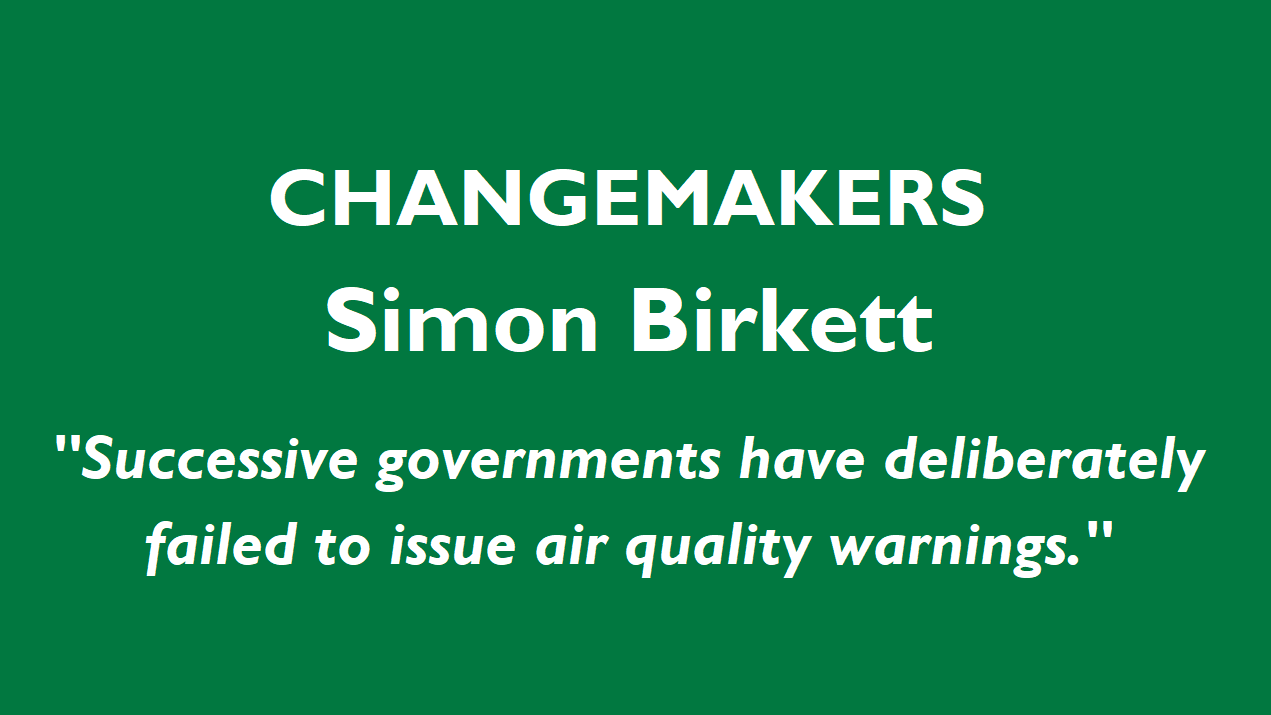
Frankly, one of the biggest and most easily fixed problems is the deliberate failure by successive governments to issue warnings about air pollution episodes since 2011. Warnings are different to forecasts, alerts, hard to find webpages and subscription notifications. People expect to be warned if they are at risk. The Met Office should be given the lead role for air pollution warnings, not Defra.
TS: People can see their children or their elderly parents becoming ill, with asthma or other serious health problems. And I guess individual stories can also be extremely important. The way you worked with [clean air campaigner] Rosamund Kissi-Debrah was perhaps an example of that. Can you say something about that?
SB: Rosamund is an inspiring figure. And Ella Roberta’s death was just so tragic; I still find it heartbreaking, to be honest. [Rosamund’s daughter Ella Roberta was the first person in the world to have air pollution listed as a cause of death on her death certificate.] My understanding is that a number of Ella’s hospitalisations occurred around air pollution episodes, and she died on 15 February 2013 during a brief break between two of the worst particle episodes. Rosamund had never been told about air pollution. And this is one of the things which I think is so wrong.
I heard about Rosamund's case, offered to help and met her. And she's such an inspiring person. Ella's story is so moving that I've been really honoured to work with Rosamund.
Ella Roberta's tragic death, aged nine, really brings the issue home to people. Personal stories, and the tireless campaigning of people like Rosamund since 2013, have been crucial for getting action on air pollution.
TS: When I was lucky enough to work with you in a small way on the Clean Air (Human Rights) Bill that you had a very big part in designing, I remember how incredibly effective Rosamund was in terms of getting support for that in the House of Lords.
SB: Yes. Jenny Jones had said to me in 2017 that she was keen to do a private member's Bill in the House of Lords. And I said, well, why don't we do a new Clean Air Act? And so I drafted that for Jenny. She checked it, approved it, and then put it in the ballot a couple of times and didn't really get anywhere. And then the third time she ended up topping the ballot of private members’ Bills.
So I had the pleasure of advising her as that got steered successfully through all five stages in the House of Lords. But having me sitting in the chamber wouldn't have been anywhere near as effective as having the huge personal force and energy of Rosamund sitting there. Almost everyone who spoke in the House of Lords started by saying how much they sympathised with Rosamund about Ella Roberta's death. And that just puts a completely different tone on the debate.
So it was a very real way of communicating what a new Clean Air Act, or the Clean Air (Human Rights) Bill, which is what we’d titled it, really means. There's no better way of understanding than hearing from the mother of a child who's died so tragically, without being warned about air pollution.
TS: Why did you put human rights in the title of that Bill? Is that something which you see as important for people's understanding of what clean air is all about?
SB: Well, I think the work I've done, going back right to the start, has pulled several threads together. I mentioned how air quality pulls together traffic, noise, health and so on. But it also includes human rights. And so that is very much part and parcel of my theory of change and justice.
And what I have worked out is that the key sentence in this whole 30-page bill is: “Everyone has the right to breathe clean air and the Human Rights Act 1998 is to be read as though this were a Convention right.” What it would mean is that in every decision by every public body, every minister, all the time, they would need to consider clean air in the way they currently consider equalities. And to me, enshrining that particular legal understanding of a human right precisely and explicitly in UK law – which of course you can reach from the European Convention of Human Rights in terms of protecting the right to life (article 2) and respect for private life (article 8) – is the quickest, cheapest, surest way to action on clean air, or ‘one air’, because it doesn't usually cost anything and, if it does, the benefits usually vastly outweigh the costs. All it does is to require better decision-making, and it can happen instantly. That's why we put it in there.
In terms of the Bill’s short title, there were a couple of other clean air Bills already floating around that year, and the legislative office said that they wanted to call ours the Clean Air Number Three Bill. I called Jenny up and suggested we call it the Clean Air (Human Rights) Bill, and of course, Jenny immediately said yes.
Jenny topped the ballot in May 2022, and what was also really important is that in July that year the UN General Assembly adopted a resolution recognising the right to a clean, healthy and sustainable environment as a human right. So there was a lot of international effort going on at the same time. Then at the end of October that year, the European Commission published its proposals for the new Air Quality Directive. And so it just all fell together. But the government of the day and successive governments have not picked it up, despite the Green Party and the Liberal Democrats both committing to a new Clean Air Act in their manifestos. The others have not picked it up.
TS: That leads on to another question, which is about the barriers to change. Why have governments not picked it up? The Bill passed with almost universal cross-party support in the House of Lords. But why has it been so difficult to get it taken on through the Commons?
SB: The evidence is that successive governments have regarded air pollution as a politically sensitive issue. Too sensitive.
As one example, political considerations are likely to have been behind the government delaying the publication of its Air Quality Compliance Assessment Summary for 2025 until the morning after the Holborn and St Pancras by-election on 8 October [2026], where the Green Party was the main challenger. The report revealed that London has reverted to illegal air pollution levels.
I’ve also mentioned, a couple of times, that governments seem to have decided not to issue potentially life-saving warnings during high air pollution episodes since 21 April 2011. Worse, they seem to have used their communications failure then as an excuse for 15 years of inaction. This inaction hasn’t been because there is too little interest in air pollution but because there is too much. We should harness that public interest better.
Of course, some of the obvious people are also barriers to change. So, the legacy industry types – I think you can guess who those might be, some of the big industries and other vested interests; polluters who don't want action.
TS: Has there been concerted lobbying against this kind of change towards cleaner air?
Of course. Well, the wood-burning stove industry has sent letters, arguing for different approaches. Let me put it that way. And I think we saw some of that, more recently, around the Future Homes Standard. Clean Air in London put in an FOI request to ask what letters the government had received from different organisations or industry bodies.
But I think we shouldn't single out a single legacy sector, because there are a whole lot of sectors, and billionaires and others, who don't want change or who see opportunities to create chaos and divide the public. And as I’ve said before, politicians won’t do things that they don't want to do and don't have to do.
If you look back at the 2024 general election, Labour were doing everything they could to get elected. The Conservatives were saying they were going to roll back clean air measures of different sorts. So Labour didn't have to say that they would do anything. They basically just had to be silent on the subject, which in fact is exactly what they chose to do, because anyone who did want action would be, if that was their key issue, deciding they'd vote Labour, not Conservative.
So Labour didn’t say anything about clean air or air pollution in their whole manifesto, which is frankly outrageous. Because if they had, a lot of people might have been happy about it, but someone somewhere might have run one newspaper column saying, policy X was daft, which might have cost them 500 votes. By saying nothing, they avoided the chance of that happening. So I think it was shameful that they did that, but I think that they were desperate to get elected after being in opposition for so long.
TS: The whole thrust of Labour’s manifesto was about growth and obstacles to growth, and doing away with any of the sort of ‘annoying’ legislation that might get in the way of growth.
SB: Growth is the money tree of all time. If you've got growth, you've got a money tree throwing money off. So it's a bit of a silly thing for Labour to have said, but it sort of makes sense. And then, a lot of what they've done subsequently has been making growth less rather than more likely. But on the environment, the only subject that they really mentioned in their manifesto was dirty water, because there'd been a lot of very successful public campaigning.
I have to say I really admire what the campaigners did on dirty water between 2021 and 2024 – making it a really big issue, where political parties had to say something. But what Labour were able to say or do was to blame the water companies. They didn't actually have to do anything else but could say it's someone else's fault and we'll try and do something to stop them.
TS: You've talked about how you've used press releases focusing on things like air pollution warnings and Boris Johnson's underhand way of trying to disguise the air pollution problem. And that's obviously been very effective. You've also used social media, quite a lot, I think. And I think you've written about how useful a platform like Twitter was for you. Do you still feel the same way about that? I'm thinking about how Twitter has changed and the extreme amount of disinformation on it, often about environmental and climate-related things.
SB: In terms of a campaigning approach, let me put it this way. In business, you think of ‘product’ and ‘marketing’. My model or theory of change is ‘content’ and ‘communication’. So I do forensic analysis: work out the facts and try really quite hard to stick to them, I mean – and it's actually really difficult to do it, hoping not to make mistakes. ‘Content’ and then ‘communication’.
And my approach to communication is what I call ‘wholesale’, not ‘retail’. So what I've done is to focus on that communication being to policymakers, to politicians, and to the news media, because it's been much more valuable in terms of ‘return on effort’ for me to get a front page splash in the Evening Standard – such as a Red or Black air pollution warning, which can reach 500,000 people – than to go out to a community group and talk to 20 people, which takes me a whole evening and is, quite often, very exhausting.
On the eve of the ULEZ starting in central London in April 2019, I was in the BBC studios to do an interview at about half past eleven on a Sunday night, with BBC World Service Radio. And I was standing in reception and had a call from the central news desk saying, could you stay on until 2am and do an interview on our global 24-hour television news bulletin. And I said, well, look, that’s a fantastic opportunity, but I've got to be up at seven to do a radio interview with one of your BBC London colleagues. And so they said, well, wait a second, we'll call you back. And they called back and said, right, we'll run it, at midnight, 1am and 2am. Will you do that? And I said, yes. That meant that I was top item of the BBC World News between midnight and 2am – before anyone else had even woken up, it was all across all the airwaves. That's what I mean about ‘wholesale’. It reaches many millions of people.
And I've done that with the ULEZ expansion – twice. I was quoted in over 300 articles in 19 countries in August 2023, and the quotes they focused on were that ‘big problems need big solutions’, and ‘we know that low emission zones work’. So those two messages were carried around the world. And, that’s my model of campaigning: ‘content’ and ‘communication’ and ‘wholesale’, not ‘retail’.
Clean Air in London has published about a million words, including most of its campaign letters, on its website at cleanair.london. There’s lots more on Twitter/X.
TS: I wonder if you're seen as a more reliable or credible source for that kind of information than if you were a more stereotypical eco-campaigner. Do you think perhaps that it’s helpful that you come from a very different background?
SB: You can be effective with many different approaches. But I think it helps to build up a reputation or track record, let me call it that, as someone who is a reliable commentator on a subject; something you build up over many, many years. And you can, as they say in the business world, lose your reputation in ten minutes.
So, the BBC, I guess, and other news outlets, can do as much research as they want, but they know I've been quoted literally thousands of times by hundreds of media organisations all around the world. Not just in the UK. In January 2013, I had an e-mail one Sunday morning from China, from Shanghai, saying, would I answer eight questions in the next two hours? So I sent detailed answers and they published them in the newspaper that went out to over 500,000 people in Shanghai the following day. I did something similar with them again in December 2013 and suggested an extra question on health impacts. They published my answers, with a drawing of me.
On an earlier occasion, in April 2010, between the Beijing and London Olympics, I was invited to do a live interview with China Radio International. So I had to get up at two in the morning and they asked me a whole lot of questions. And there I was saying what I actually believe, which is that the Beijing 2008 Olympics showed how the Chinese can tackle air pollution – as they did, successfully, with controls on traffic, coal-fired power stations and industry. How they could achieve blue skies. They knew how to do it and had showed they could do it. Whereas in London, the UK was not showing signs of gripping the problem. Just to be able to do that and probably have some British ambassador sitting in the back of his car in Beijing going into work, listening to all of this… I suspect they had a heart attack.
Another favourite was being the opening keynote speaker at CASANZ’s [Clean Air Society of Australia and New Zealand] annual conference in Melbourne in September 2015 on the Monday morning after the first dieselgate revelations in California the previous Friday. The Minister pulled out of their speech later that day and the following morning I was interviewed for 15 minutes on national radio. I produced a film, ‘One Atmosphere’.
I've had friends of mine get in touch saying they'd seen me on Australian TV or in Time, the New York Post, New York Times, Washington Post – all these people have interviewed me over the years.
At the heart of all this, it gets back to telling people about air pollution. Governments don't like telling people about it for all sorts of reasons, as we've seen with warnings. And, you need to try and find a way of communicating it powerfully. When I'm doing media interviews – the big ones that are planned in advance, say live with BBC – it will literally take me 24 hours to distil something down to a ‘soundbite’, or a 15 second ‘grab’.
I'll give you an example. Jaguar Land Rover (JLR) invited me to their inaugural ‘Tech Fest in London’ in September 2017, a sort of global press event they were doing. They had journalists from around the world. And they put me on a panel on the top stage for a session titled ‘We need to talk about diesel’. And there was a [BBC Radio 4] Today programme presenter moderating the panel. They turned to the JLR person and said, “Well, what do you think about clean air?” He said something. And then the moderator turned to me and said, “Well, Simon, presumably, you don't agree with that?”
And I looked him straight in the eye. I’d literally spent a month working out what I was going to say. And I said, “Diesel is the devil. We need to ban it. The more important questions are, which vehicles, when, where, and how?”
Pause. He literally didn't know what to say. And it was such a long pause that I actually turned to the entire room with all the TV cameras and the journalists and slowly repeated the same line and then turned back to the moderator. And he said, “Well, I don't quite know what to say” or something like that, which was obvious at that stage. That's what I mean: content, communication, change the world.
TS: JLR must have been rather regretting that they'd asked you to this event.
SB: But I'm not sure they quite understood the real impact of what I'd said. And I don't think they really ever believed until much later that it was an all-electric future for vehicles. I think they still thought there was a role for combustion. So they still thought, well, he might have had some impact, but surely he's wrong. I don't think they were as worried as they should have been.
The point I'm trying to make is that it had literally taken me weeks – while I was hiking up mountains – to work out what to say. I knew it was a really important event I was going to. I knew I would get a chance to say something. And the question was, what was I going to say? And, crucially, how I was going to say it. And I think that's really important. Use the opportunity.
TS: Do you see a role for non-violent direct action? It's obviously not something that you've been involved with yourself, and it's maybe not something – surprisingly perhaps – that clean air campaigners have been doing in recent years in the same way that climate campaigners have.
SB: My focus is on putting good laws in place and getting them enforced. I'm also very keen if I possibly can, to comply with the law. And what concerns me about the sorts of non-violent direct action you suggest is that it can be a bit of a grey area. I'm not quite sure what it means. And that clashes with my approach. That's a key reason why it's not something that I would think of getting involved in.
Having said all that – because that's my bottom line – lawful protest, as we saw before the changes to the Climate Change Act in 2019, those big protests in Oxford Street, have achieved a great deal. But I'm better suited to researching a topic and writing it up, and talking to politicians or policymakers or the media, than standing on the street. I think that really is my role.
TS: Just one final question. How are you feeling in terms of optimism or pessimism about the future for clean air and more widely? Do you see much to give you hope that the kind of positive change that you'd like to see can actually happen?
SB: Opportunity, opportunity, opportunity. The opportunity for making a cleaner, healthier, happier world really is so motivating, and for me the source of real hope. We’re in the 70th anniversary year of the first Clean Air Act, which frankly transformed the world. We can do that again.
But what’s really important is that we don't give false hope to people, because to me that's really like greenwashing. We need to be realistic.
To me, success would be full compliance with WHO’s 2021 guidelines, enshrining the human right to breathe clean air precisely and explicitly in UK law, matching or exceeding EU air pollution laws, and a huge public health campaign to build public understanding of air pollution. Crucially – and I really do emphasise this – the government must let an independent Met Office take the lead on air quality warnings with press releases to the news media and other weather presenters. They must be allowed to treat air pollution in the same way they treat other weather hazards, with Red, Amber, Yellow and Green categories. The French do this extremely well during ozone and wildfire smoke episodes, with health advice and action on pollution sources, including volatile organic compounds which fuel tropospheric ozone episodes in summer. The air pollution warning bands must align to WHO guidelines.
We also have to ban visible wood smoke. It's unacceptable that we can still see smoke 70 years after the first Clean Air Act. We need to phase out wood-burning stoves within the gas grid – in accordance with the Climate Change Committee's longstanding advice to government and to protect health. I’ve also called for London to be the first vegetarian megacity [which Clean Air in London defines as 51% of people choosing mostly vegan or vegetarian food], to slash ammonia and methane emissions.
So, to me, that’s really the opportunity here: to give ourselves a much better world – and complying with those WHO guidelines throughout the UK and elsewhere would be the true test of that. We need a lot more action from the new Burnham government. But, using the sort of the tools and skills and the sort of the approach that I've suggested, and encouraging and enabling people to be heard – as real justice demands – would, I think, create a virtuous circle of public understanding, legislation, enforcement, and action from politicians, businesses and citizens.
Air, climate, water and contaminated land can all be part of a new theory of change where a focus on one can lead to wins for all.