Closing the Sovereignty Gap
Mark Carney’s speech at Davos has ruffled feathers and sparked intense debate over what it truly means to stop pretending the old world order still exists. At Green House Think Tank, many of us are hopeful this signalled a message to the neoliberal establishment: the time has come for states to reclaim their sovereign power. Now that the adults are back in the room, we must begin organising around the real limits of our economy. We can no longer operate under imagined constraints born of a false ideology – one that treats a government’s balance sheet as if it were a finite hoard of gold in a vault.
We are past the era of pretending, of putting up our signs as Carney said, and acting as if this extractive rentier plantation that we call a domestic economy is anything but a tool to blindfold the masses while those who understand the system can accumulate more wealth, consolidate power and corrupt our politics. Is it a surprise that the Greens have attracted more working class voters on economic issues? The idea that a rich group of elites will be sensible to lead humanity out of this mess has been utterly discredited in the last year.
Let’s go back to the basics, shall we? It’s time to take the children out of the room while we discuss real problems that require the mobilisation of real resources at the national level if we are going to realistically fulfil our commitments on the international level. In an era when supply chains are weaponised, when the financial system is used as leverage, when entire governments can be bribed by an extra-national elite, the immediate objective is to rebuild the power of the state. Without protecting the state and its institutions, there is no democracy; without democracy, we lose our agency to act, and we remain at the mercy of international oligarchs.
We are not talking about the false nationalism that is peddled by the same international elite to divide populations on ethnic or religious lines. It’s time we stop playing these games that use the "blood and soil" rhetoric to do everything but restore our sovereign power. It is these same people – those so-called patriotic nationalists – who threaten to leave, move headquarters, profits, and factories across borders on short notice to avoid taxes or environmental laws. Real patriots are rooted in their communities. They cannot simply "move" to a new country if their local economy collapses. Real patriots care what happens to our waterways, our neighbours, and the very soil they claim to venerate. You cannot profess a love for the nation while poisoning its land for a quarterly dividend. You cannot wrap yourself in the flag while pulling the rug out from under the workers who stitched it.
For too long, the media has constrained political discourse within a linear Right-Left spectrum, granting the so-called "Right" a monopoly on national pride. Yet, the Right’s position is paradoxical: it demands minimal state involvement in the economy, effectively handing the levers of state functions – and the very land it claims to defend – to private and foreign interests.
This raises a vital question: who are the true ingroups in this framing? Does a wealthy Englishman residing in Monaco care more for this nation than the immigrant nurse with a personal stake in her community's wellbeing? Are the propagandists who hijack our tribal instincts truly concerned with the public good, or are they simply weaponising national pride for votes? There is nothing wrong with national pride, but the establishment has treated nationalism as a private commodity to be marketed and sold, while the media plays along. It has turned concern for our fellow neighbours into a racial divide. It has facilitated the theft of our nation's endowment of land and economic power by a supra-national elite who have been elevated to a higher position than our own sovereign government.
The time has come to re-examine these labels. The current framing of Left vs Right is outdated. China’s nationalism is neither Left nor Right. Anti-corporate resource nationalism in the Global South defies Western narratives. The Muslim concept of Waqf – an endowment given to God that effectively places land and economic activity permanently in the public trust – exists in a spiritual dimension far beyond this linear political model. Similarly, many indigenous peoples view the land as separate from both State and private property; the Native American perspective holds that the earth belongs to the Great Spirit, with humans acting as stewards of a sacred trust that cannot be fenced or auctioned.
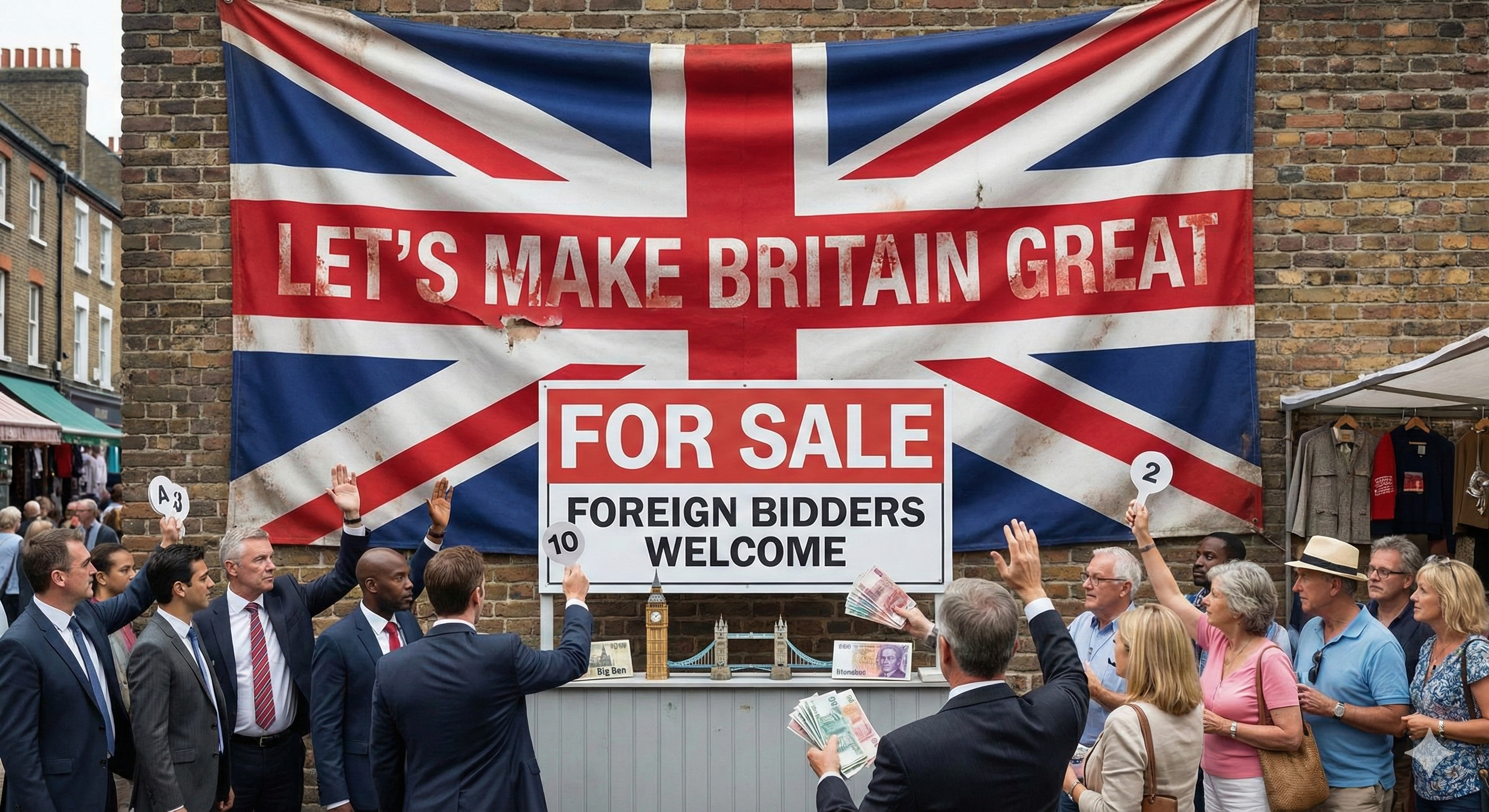
No, the political construct of the "Right" does not have a monopoly on nationalism, nor the definition of who belongs to the land. Its view of nationalism as something to be branded, marketed, and sold back to us – while the actual substance of our sovereignty is auctioned off to the highest bidder – must be called out for its hypocrisy. It offers us a theatre of culture wars to keep us distracted while they hollow out our institutions. It wants us fighting over symbols so we don't notice they’ve abandoned the substance. We belong to this land because we have a stake in its stewardship and in the communities who depend on it. We do not belong to this land because we "own" it.
Real nationalism has a "civic" dimension that's necessary to hold our Government to account. It demands that we bridge the "sovereignty gap" created by the neoliberal era: the growing discrepancy between a state's legal recognition (de jure) and its actual capacity to function (de facto). Even Mark Carney has acknowledged what the Greens have said for years: globalisation carries immense risks. We must transition to an economy that produces locally, rejects the exploitation of labour, and respects the physical limits of the natural world.
The era of neoliberal dominance must end; it is time for its proponents to step aside. To understand true fiscal sovereignty, we should return to the foundational insights of giants like Keynes. Contrary to the narrative promoted by banks and financial intermediaries, the state possesses the ultimate legal authority to create money, and we should be voting out any politician who seeks to diminish this sovereign power in favour of surrendering our monetary sovereignty to the banking and foreign sectors.
Recognising Our Sovereign Money Power
To restore our nation, we must first restore the State's fiscal power, and that means the recognition that not every problem can be solved by banks and private funding. This was the national ethos that Britain had in the aftermath of WWII, when we embarked on the most ambitious rebuilding of the nation, building the NHS, building the welfare state, and creating the most prosperous generation in British history.
Today, public perception often equates "money" solely with bank deposits – overlooking the role of government-issued bank reserves, deposits held with Government-owned entities (NS&I), and circulating physical currency. It is worth noting that bank deposits are merely a bank's "promise" to settle future transactions using state funds. Because deposits are backed by loans, securities, and reserves, a bank’s actual liquidity (or ability to settle a transaction) depends entirely on the latter two: government securities and reserves.
It follows, therefore, that our bank deposits can only be honoured if banks hold enough government securities (gilts) and reserve balances at the Bank of England, which basically means that the "real" money backing our deposits is this parallel system that exists between banks, the Treasury, and the Bank of England. The “real” money is the very national debt that our politicians tell us must be reduced.
Still not convinced? Our Government’s debt accounting figures include currency and deposits issued by the Government as debt:
| 2026 JAN (£ million) | |
|---|---|
| Central government debt | |
| Gilts outstanding | 2,630,568 |
| Currency and Deposits | 269,179 |
| Other debt securities and loans | 161,222 |
| Total central government debt | 3,060,969 |
The only difference between this and the Maastricht debt figure used for international comparison is the inclusion of local government debt and exclusion of cross-government holdings where one Government entity holds a debt asset of another Government entity:
| Total central government debt | 3,060,969 |
| Total local government debt | 137,319 |
| Total Cross holdings | (121,397) |
| General government consolidated gross debt (Maastricht) | 3,076,891 |
These currency and deposits are the notes in our wallets and the deposits in our NS&I accounts. Just as bank deposits are the banks’ IOUs, no one would disagree that these Government IOUs should be considered "money" in the colloquial sense of the term. In the Government’s accounts, all “money” is a promise to honour the currency of account when the tax bill comes due. Here is where the neoliberal logic falls flat on its face: it claims that Government must find the money to spend, but it fails to acknowledge that money is debt, an IOU issued by a bank or a sovereign government.
In fact, the only reason that bank deposits have any value is because they are backed by bank reserves, the promise to settle payments using the very money created by the Bank of England that is backed by gilts. So, in effect, the Gilts are simply another form of "money" because the Bank of England creates bank reserves by buying gilts.
Keynes understood this. In his wartime pamphlet, How to Pay for the War: A Radical Plan for the Chancellor of the Exchequer, he argued that the fundamental economic problem is not "finding the money" but organising real resources like labour, capital, and materials. He recognised that for a sovereign state, money is a creation of the state, a token defined primarily by what the Government accepts at "public pay offices" to settle tax obligations.
Rebuilding the Nation State
This understanding is essential for closing the Sovereignty Gap, the discrepancy between a state's legal status and its actual power to function. By moving past the pleasant fiction of neoliberal constraints – "imagined constraints" of the gold-standard era and self-imposed constraints of central bank independence – the state can reclaim its de facto ability to provide services and manage the economy. In this framework, spending precedes taxation in a logical sequence: the state must first issue its unit of account via spending before the public can obtain it to pay taxes using this unit of account.
Keynes’s insights provide the foundation for a Civic Nationalism that empowers the state to act as a defensive shield for its citizens. Keynes recognised that global capital is "liquid" and can cross borders to avoid regulation, and he understood that a nation’s people are grounded in their communities and rely on a functional state to manage the real resource constraints that are the real source of inflation. These include labour, energy, skills, technology, materials, infrastructure and industrial capacity. The true constraint on sovereign spending is not solvency or an exogenous financial budget; it’s the economy's capacity to absorb it without generalised price increases.
In sympathy with Keynes, many of us at Green House Think Tank view taxes as a macro-economic stabilisation Tool. Taxes do not "fund" the state; they withdraw purchasing power from the non-government sector to create space for state-led objectives, such as a green transition or doubling defence spending, without driving inflation. The National Debt is the other side of private sector financial wealth. Public debt is the non-government sector's net financial asset. The "real" money is the parallel system of gilts and reserves that allows the banking payment system to function.
Nationalism need not be exclusionary, and we can build a state that coordinates capital around national power and resilience. This is not the "plutocratic populism" of culture wars used by elites to distract the public while they hollow out institutions. Instead, it is a reclamation of sovereign power to ensure that "anything that can be done is affordable," provided we have the physical resources and the political courage to mobilise them.
Related Publications
 Emma Dawnay
 Zaid Alasad
 Zaid Alasad