
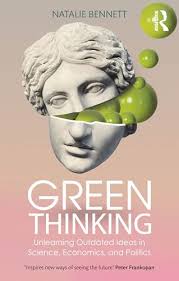
Book Review: Natalie Bennett's "Green Thinking"
Interested in debating the ideas in this book with Natalie? Sign up to attend our first online book club at 4.30 pm, 13 Sep. Email events@greenhousethinktank.org to sign up for the Zoom meeting. See footnote to access special discounted copy of the book.
To find Bennett*, a former editor of Guardian Weekly, is a great writer – pithy and succinct, who effortlessly weaves personal anecdotes with serious analysis should surprise no one. What did astonish me was the breadth of references she’d packed into this 240-page book. It is an intellectual tour de force, gliding eclectically across academia (anthropology, biology, economics, and history), science fiction, esoteric sources (indigenous Australian beliefs) and political speeches and writings.
The book sets out to overturn our presumptions about the arrow of Western capitalist progress and remind us of the contributions of other human traditions and other species. It relegates bad and misguided ideas “onto the compost heap” and offers an alternate green perspective. A decade ago, I had the privilege of being in the same north London book club as Bennett and recognise many of her ideas from our debates over books by David Graeber, biologists Lynn Margulis & Peter Godfrey-Smith, economist Ha Joon Chang, and systems thinkers like James Lovelock.
The book’s eight chapters each feature a big idea Bennett seeks to debunk. But just as a river struggles to restrain itself to a single channel from its source to its mouth, Bennett meanders across the terrain, drawing in tributaries of execrable thinking which are developed into distributaries of green thought. She fails to confine her dissent to just eight bugbears. Each chapter clear-fells large swathes of deadwood thinking.
For instance, chapter 7 “Money makes the world go around” is ostensibly a critique of government’s obsession with measuring and growing the amount of money. Bennett starts contrasting John Maynard Keynes’s 1930s fantasy that his grandchildren would work three-hour days with current capitalism’s malign make-work that occupies producers’ and consumers’ time with “shoddy, ephemeral, dysfunctional products, cheap and meant to be quickly discarded”. And this is just the first two pages of a twenty-page chapter. This chapter criticises soulless jobs for being boring and repetitive, and not without hazard, noting workers at Amazon UK suffered 1400 injuries in five years requiring ambulance treatment. It goes on to fume “there is too much finance”, echoing critiques by Yanis Varoufakis that governments and financial regulators have blindly capitulated to the tumorous growth of lending and indulged the City’s self-serving pleas to ever increase liquidity, complete markets and price risk, provoking financial transactions serving financiers, not the real economy. The chapter concludes by asking if debt needs to be repaid. This recalls the Jubilee Campaign at the turn of the century. Why should debts incurred by Global South dictators be serviced by defunding health and education budgets, long after the despot is deposed and the enabling banker paid his bonus? It commends Iceland, which shrank its financial sector from its ruinous pre-2008 size, of 900% of GDP, to make the economy more balanced and better serve local interests.
Much of her critique will be well known to Green House Think Tank subscribers. The first chapter attacks the Darwinian idea of nature as “red in tooth and claw”. Biology now identifies co-operative and symbiotic relationships within nature. Biologist Lynn Margulis emphasises the centrality of symbiosis, proposing that the mitochondria inside plant and animal cells, supplying the energy vector ATP via the oxidation of glucose, are the result of an archaic symbiosis between bacteria and single-cell organisms. Similarly, microbes and fungi have mutually beneficial relationships with plant roots and algae, trading micronutrients and minerals for sugar from their photosynthesising partners. In a similar vein, chapter 2 challenges the idea of humans being innately acquisitive, noting our 200,000-year-old creative impulse evidenced in cave paintings, ornate ceramics and weapons as old as language. Chapter 5 attacks our society’s replacement of natural habitats with her ugly neologism “plantationocene” which speaks not just about the replacement of nature with farms and forest but also the tedious uniformity of cities with identikit buildings, fields of a five or so domesticated crops all with uniform germplasm.
Chapter 9, “A great leader will fix our problems”, questions political leadership. Westernised societies’ operating systems now default to the ideal of representative democracies where we devolve political decision-making to elected government. Those on the progressive side are acutely aware that true power is harder to pin down, slipping like grease in the political machine to those with wealth, connections and social platform. Here in India, the cockroach movement is the most recent manifestation of this disillusionment. Young people, even those who play by the rules and excel at the game, still feel dignified opportunities to live and work slip away. She notes that “In the mid-1990s social democrats won the elections but lost the arguments.” Governments led by Clinton and Blair presided over nominally left-of-centre governments that privatised public assets, weakened safety nets, and stressed competition over regulation just as cheerfully as Reagan and Thatcher. They were replaced by mushy centrist leaders in the 2010s like Merkel, Cameron and Obama who neither ignited passions nor reversed the slow decline in Western economies’ ability to maintain full employment, affordable homes and sustainable energy use. I was surprised to see Bennett select the “Nudge theory” and the tech bros’ “Solutionism” (where technology fixes social ills) for the compost bin.
Even well-read readers acquainted with the standard green texts have much to learn from the book. As someone who now lives in India and has travelled widely in Eastern Europe and Central Asia, I was surprised to learn of the role played by the nomadic Scythians in the 8th- 9th century BC transmitting culture from Central Asia into ancient Hellenic, Mesopotamian, and Persian society, pre-empting similar cultural transmission by the Mongols 1500 years later.
The book proposes few fixes. It instead helps us unlearn mistaken presumptions about how the world works. Only through this act of decluttering do we free up space to receive new ideas. Fittingly, the last chapter talks about rethinking knowledge and discusses how universities can avoid wealth influencing academic freedom (sic., Jeffrey Epstein’s $25 million donation to Harvard endowing its program on mathematical biology and evolutionary dynamics).
This book is a testament to Bennett’s position as a leading Green intellectual and should be read by anyone seeking a succinct, well-evidenced critique of the mental models that bedevil current policymaking.
*Bennett was leader of the Green Party (England and Wales) between 2012-2016, and sits in the House of Lords.
To buy the discounted book click on the site: https://www.routledge.com/Green-Thinking-Unlearning-Outdated-Ideas-in-Science-Economics-and-Politics/Bennett/p/book/9781032640273 . The discount code GRNTK2026 grants 28% off the retail price