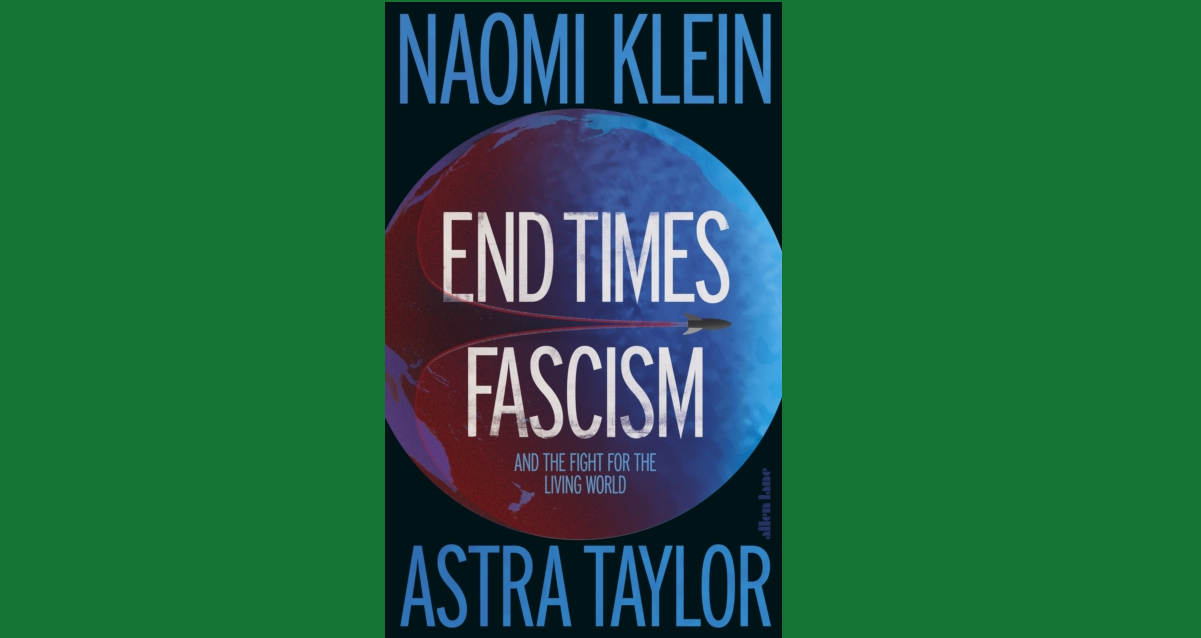
Review: End Times Fascism and the Fight for the Living World, by Naomi Klein and Astra Taylor
If you'd like to discuss the ideas raised in this book with Green House's online book club at 4.30pm on Sunday 6 December, email events@greenhousethinktank.org (NB: the date of this has changed from 15 November.)
The tendency to try to understand politicians like Donald Trump, Nigel Farage, Alice Weidel or Marine Le Pen by reference to fascists of the last century is very evident on social media. And what has been called the reductio ad Hitlerum is mercilessly mocked by right-wing commentators.
After Elon Musk made what appeared to be a Nazi salute at a rally celebrating Trump's second inauguration, Musk dismissed the ensuing outrage with a tweet: “Frankly, they need better dirty tricks. The ‘everyone is Hitler’ attack is sooo tired.”
End Times Fascism and the Fight for the Living World is very far from being a reductio ad Hitlerum. Naomi Klein and Astra Taylor seek rather to understand the impetus driving the rise of today’s far right in the context of a world that is radically different from that of the 1930s, and to connect it in particular with the existential threat of climate and ecological catastrophe, and the development of artificial intelligence technology.
As they note, fascism has always had what Umberto Eco called an “Armageddon complex” – a sense of an imminent “final battle, after which the movement will have control of the world”. And religious millenarians have long tended to see global crises as confirmation of biblical prophecies heralding the end of days and the salvation of the blessed.
Klein and Taylor describe the ways in which more ‘traditional’ ethnonationalist fascism has coalesced with religious end-times thinking and with a powerful new strain of millenarianism: the ‘accelerationist’ fever dreams of the Silicon Valley oligarchs, who believe that achieving artificial general intelligence (AGI) will grant them superhuman powers while rendering the rest of humanity redundant (literally and figuratively).
Underlying all these types of thinking is the idea of escape from the world, whether to a heavenly kingdom, an ethnically cleansed garrison state, a luxuriously appointed survival bunker, or even – in the case of Elon Musk – a colony on Mars.
All of this might seem fantastical, were it not for the fact that some of the world’s wealthiest and most powerful people now appear to be motivated by such beliefs. And even if the end-times scenarios they envision may differ, the convergence between these strands of apocalyptic ideation is already having profound real-world impacts in everything from the roll-out of massively destructive data centres to the US/Israeli “holy war” on Iran, with AI supplied by Palantir selecting targets for American bombs.
And all this is happening in a world that seems to be hurtling towards ecological collapse, social breakdown and ever-widening war. As Klein and Taylor write: “One of the dangers of the concentration of all that military, monetary and technological power is that it can make the trajectory towards Armageddon seem unstoppable. It can even convince us that the end-times fascists might be right – maybe the vast majority of humanity are truly doomed.”
Klein and Taylor shed a great deal of light on the long-standing connections between religious fundamentalism and right-wing politics in the US, and particularly on the role that Israel has played in this. They trace how Christian messianism and Zionism have interacted, to the extent that Benjamin Netanyahu is on record as saying: “I consider CUFI [Christians United for Israel – a US lobby group claiming ten million members] to be a vital part of Israel’s national security.”
They also identify striking parallels between the messianic language of AI’s corporate prophets and that of religious eschatology (though AI insiders seem divided on whether they are engaged in summoning a digital deity or a world-destroying demon). And, in Chapter 4, they give a detailed account of how the alliance between Trump, the tech bros and fossil fuel interests was forged by Palantir founder Peter Thiel (a keen, if unconventional, amateur theologist who has repeatedly asserted that Greta Thunberg is a “legionnaire of the Antichrist”) and his protégé JD Vance:
"Most consequentially, they put their case for a massive bet on AI into language Trump would appreciate: America needed to dominate, be number one, beat China. And the best part of all, deregulated AI and crypto sectors would burn unfathomable amounts of gas and coal, which would greatly benefit Trump’s beloved fossil fuel sector, a key source of contributions to his campaign. If Trump got on board the anti-woke, energy-guzzling rocket ship these men were financing, they would be the best – and richest – friends any politician could dream of."
For the tech bros, an alliance with right-wing politicians was vital to protect their ability to appropriate wealth on an unprecedented scale:
"Replacing human labour on the scale they intended was a full-blown revolution, one that would generate levels of resistance these companies had never encountered before. They needed a true partner to make it all happen, one willing to roll over all public opposition, dispense with their enemies, demolish any regulatory roadblocks, and push through the necessary changes whether the public (or even some pesky executives) wished them to or not."
The appointment of Musk to head Trump’s so-called Department of Government Efficiency and the evisceration of US government funding programmes (with the help of Palantir software) was, Klein and Taylor write, the apotheosis of Silicon Valley’s vision of “an emerging system of corporate-dominated post-democratic control”. Needless to say, climate science and clean energy programmes were among DOGE’s first victims.
Some readers might question the extent to which Klein and Taylor justify the term “fascism” to describe the developments they document. Definitions of fascism have tended, inevitably, to focus on the ideologies that wrought such havoc in the twentieth century and, as James McDougall, Professor of Modern History at Oxford, has observed: “Discussion of fascism suffers from an excess of definition. That often, ironically, allows far-right groups and their apologists to disavow the label because of some tick-box characteristic which they can be said to lack.”
Many eminent historians have drawn parallels between twentieth-century fascism and the contemporary far right, not least Timothy D. Snyder and Ruth Ben-Ghiat. Snyder is too good an historian to suggest that what we are seeing is simply a case of history repeating itself. But, as he has said: “Those who know the history are better equipped to see both the dangers and opportunities. History shows that things that we don’t think are possible might well be.”
There may be rather more direct correspondence between twentieth century fascism and today’s far right than Klein and Taylor indicate. In Alt Reich (2025), Nafeez Ahmed traces the influential role that US organisations such as the Pioneer Fund (which distributed Nazi propaganda in the 1930s) have continued to play in promoting so-called “race science” in the US and Europe. The AfD’s ties to neo-Nazi organisations are well documented. Peter Thiel has cited the Nazi ideologue Carl Schmitt as a key influence on his own thinking. And, extraordinarily, when Palantir CEO Alex Karp was interviewing Oswald Mosley’s grandson Louis Mosley for an executive position at the company, he began the interview by quoting from memory a long passage from a speech by the notorious Blackshirt leader in which he called for Britain to seek peace with Nazi Germany.
Klein and Taylor are not overly concerned with checking historical tick-boxes, however, and spend little time on events of the 1920s and 30s. Indeed, at the beginning of their book they stress that definitions of fascism that rely on markers unique to the twentieth century are liable to cause us not only to miss the ways that fascist ideology has evolved, but also to overlook the extent to which this earlier incarnation of fascism was not a "rupture" from history but itself had clear precedents in the horrors of European imperialism and slavery.
Fascism, they write, "was not an event, fixed in time and place. Rather it was a throughline in the history of modern capitalism: a set of brutal methods and strategies that moved through space and time, rising to the surface when the powerful felt injured, and when the interests of wealth and capital were under great threat from below.”
End Times Fascism is urgently addressed to the present moment, particularly in the US, and although it is well referenced does not set out to be an academic study. Readers will find no mention of influential analyses of fascism by twentieth-century thinkers such as Lukacs, Marcuse or even Gramsci. The authors’ reluctance to get bogged down in discussion of these is understandable, although Gramsci’s account of the crucial role of cultural hegemony in shaping norms and manufacturing ideological consent seems very relevant to the way in which control of online platforms has been used by Musk and others to mainstream far-right ideology.
They do, however, draw on Hannah Arendt’s landmark 1951 work, The Origins of Totalitarianism, at one point almost paraphrasing Arendt’s famous description of the ideal subject of totalitarian rule: “When our information feeds are flooded with synthetically produced slop, racist and misogynist deep fakes, and bot-generated replies, the end result is for many people to give up hope of differentiating fact from fiction.”
One weakness of Marxist analyses of fascism was perhaps their failure to engage with the power of story, of narratives which – however false – can exert a powerful emotional sway. Klein and Taylor, by contrast, have a finely developed sense of why stories matter and are themselves gifted storytellers with a journalistic eye for memorable detail.
During his long imprisonment at the hands of Mussolini, one of Gramsci’s frustrations was that his understanding of developments in the world outside his cell was limited to what he could gather from his reading: “Books and magazines contain generalised notions and only sketch the course of events in the world as best they can,” he wrote. “They never let you have an immediate, direct, animated sense of the lives of Tom, Dick and Harry. If you are not able to understand real individuals, you are not able to understand what is universal and general.”
Through sections of vivid reportage, however, Klein and Taylor give us a strong sense of what the developments they describe mean in human terms. They show you the ugly reality behind the shiny promises of the AI evangelists – the methane-powered generators belching out pollution and unceasing noise 24/7 to power Musk’s ‘Colossus’ data centres in Memphis, Georgia. And, by interviewing people involved in local resistance to these, and to the sadistic depredations of Trump’s ICE thugs in Minnesota, they show how the triumph of end times fascism is by no means a done deal.
The tech bro oligarchs have more or less complete contempt for the living world, seeing biology and the physical environment as inconveniences to be hacked, transcended or escaped. And their ambitions depend on the rest of us becoming disengaged from our local communities and disconnected from the natural world on which all life depends.
In the final chapters of the book, Klein and Taylor point towards what they see as the most fruitful strategy of resistance to end times fascism. This is a concept that they describe as “hereness”, a term borrowed from the Yiddish “doikayt“– a foundational principle of the Jewish Labour Bund, the early twentieth-century movement that resisted both antisemitic attacks and Zionism’s call for Jews to relocate to a promised land.
By “hereness”, Klein and Taylor mean a fierce commitment to fighting for local communities to be able to flourish in places that are not made unliveable by ecological degradation and economic exploitation, to assert “our equal claim to live well on the earth”:
“By rooting belonging not in where our ancestors were born but in our actions in the here and now, hereness denies the escapist fantasy that paradise exists elsewhere, in some purified future or a place accessible only to the chosen.”
To illustrate what this might mean in political terms, they describe Zohran Mamdani’s 2025 mayoral campaign in New York:
"End times fascism is all about exiting the mess of here, the complexities and frustrations of living with diversity. Paradise is perennially over the horizon, in a promised land of elsewhere, the ever-elusive Zion. The Mamdani campaign answered these fantasies with a rallying cry to stay right where we are, where we work, and where our community resides. It responded with a celebration of here, as well as a shared dream about how here can become more beautiful in the years and decades ahead. It was the kind of non-fantastical non-nostalgic, forward-looking vision that end times fascists are incapable of providing, and that huge numbers of people have clearly been waiting for."
As I was reading End Times Fascism, a slew of grim news headlines seemed to underline the most disturbing aspects of Klein and Taylor’s analysis – ongoing genocide and ethnic cleansing in Gaza and the occupied territories, intimidation of migrants by mobs of masked thugs in the UK, yet more UK government contracts handed out to Palantir, new fossil fuel licences and fast-tracked data centres, vast donations to Reform UK by crypto billionaires…
I finished the book as the results of the US midterms were coming in. Among the most encouraging aspects of these was that Democrats who made opposition to hyperscale data centres central to their campaigns were overwhelmingly elected, with more than half of all US voters saying that this issue was a “crucial” or “major” factor in how they voted (corruption and the Iran War were also high on the list of voter concerns). And this despite Musk and other tech billionaires putting more than $600 million behind their favoured Republican candidates. As the Financial Times commented, “the money didn’t work”.
This was certainly not the end of end times fascism, and Trump’s response to this defeat was to appoint as his new Chief of Staff Stephen Miller, a white supremacist who has presided with sadistic glee over the brutalities inflicted on immigrants by ICE agents. But, like Mamdani’s victory in 2025, it gave weight to one of Klein and Taylor’s more hopeful messages.
As they observe, whereas the murderous fascist regimes of the twentieth century “did use the states they controlled to deliver at least modest material benefits to members of their chosen in-groups,” their twenty-first century counterparts “have nothing to offer their voters but a bleak vision of a perpetually bunkered nation, besieged by enemies foreign and domestic”.
While people are still able to vote, this is a vision that can and must be rejected. Klein and Taylor’s wide-ranging, compellingly written and urgently relevant book will leave most readers in little doubt of that.